
The Cost of Complaining

Why Persistent Whining
Is Not Harmless
We’ve all grumbled, rolled our eyes, or otherwise vented about an unpleasant situation.
While complaining often feels natural to us (perhaps even cathartic), here’s the catch: Every time we complain, we’re training our brains to focus on the negative. Even small complaints can slowly hardwire habits that shape how we respond to future situations.
Do No Harm
Habitual complaining subtly changes our worldview by causing a cycle of tension and irritability, resulting in anger, anxiety, and what psychologists call “rumination”—repeatedly dwelling on negative experiences.
More than just a fleeting feeling, rumination strengthens certain neural pathways, making it harder to regulate emotions and respond constructively to situations.
In 2022, Chinese researchers used functional MRI studies to demonstrate a definitive correlation between rumination and altered neural activity in key areas of the brain that monitor emotions and stress. Over time, this heightened activity can disrupt the critical regions that support decision-making, self-control, and fear. Chronic complaining literally trains the brain to fixate on distress, lessening our ability to solve problems and adaptively cope with circumstances. Complaining becomes the brain’s default position.

No Whiners
Habitual complaining creates ripples that can disrupt entire social ecosystems, resulting in strained social and professional relationships, reduced social support, and diminished empathy from others.
Because they’re always focused on problems instead of solutions, chronic complainers are an emotional drain on others. They often end up pushing people away rather than getting the validation and affirmation they seek.
Here are some tips for dealing with persistent whiners:
- Set boundaries by shortening or redirecting conversations.
- Empathize—to an extent—by helping them feel heard while refraining from getting dragged into endless negativity.
- Shift the focus toward solutions by asking, “What do you want to do about it?”
- Model more solution-oriented, balanced responses such as, “I hear you. Let’s do X or Y.”
Source: TCA Counseling
In addition, persistent rumination has been identified as a risk factor for long-term impaired memory and reasoning, as well as Alzheimer’s disease. Habitual whining also detrimentally impacts social interactions. (See sidebar, “No Whiners.”)
From Whining to Winning
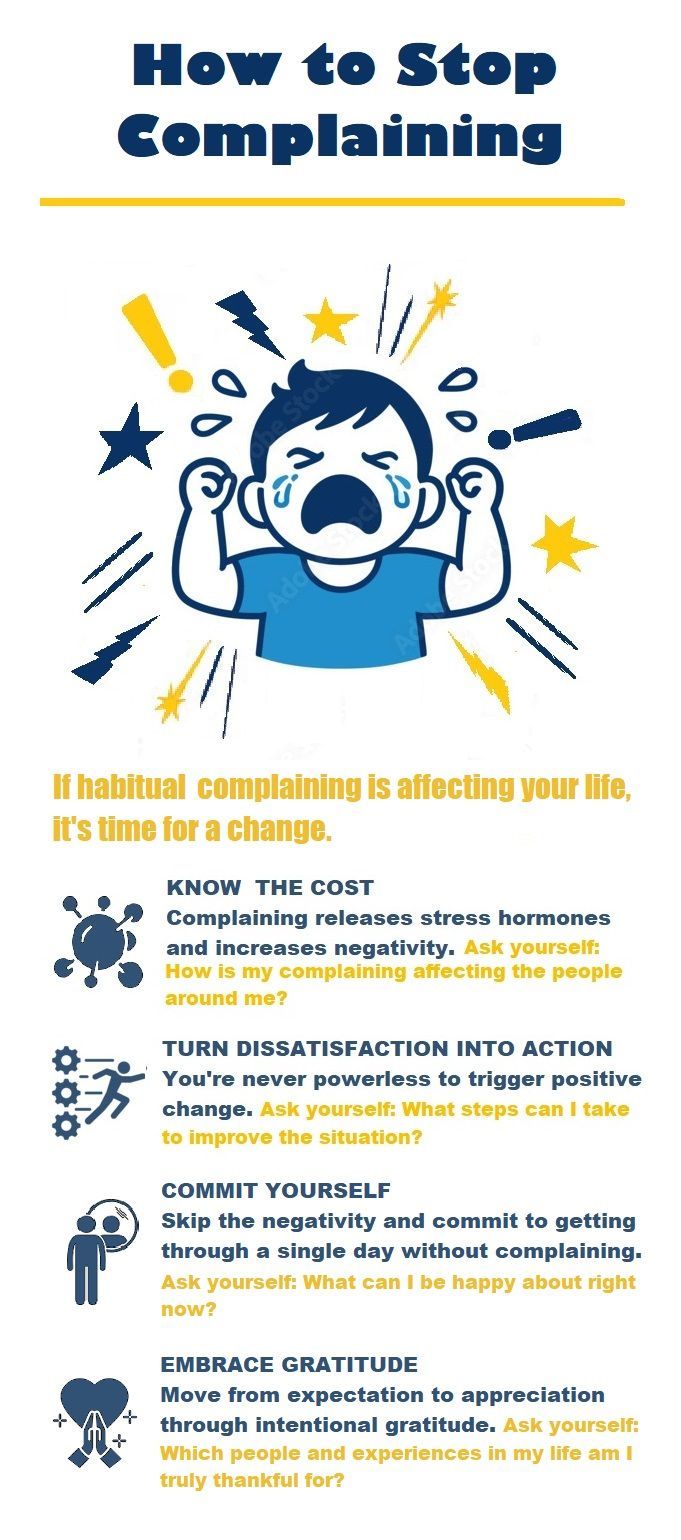
Breaking the habit of complaining requires conscious effort, but our brains can be retrained over time with small, consistent strategies.
If you find yourself habitually whining about people and circumstances, behavioral psychologists suggest the following:
Become Aware
Awareness is the first step. Notice when your thoughts begin to drift toward negativity before they escalate. The act of awareness creates a pause, allowing us to respond intentionally rather than react habitually.
Once you become aware of your negative thoughts, you can begin to accept and reframe them. Accepting circumstances as they are—rather than resisting them—reduces irritation and emotional reactivity. Reframing entails viewing situations from a more neutral (or even positive) perspective.
Consider Others
If you view a situation from another person’s perspective, you can further disrupt habitual complaining. Complaining focuses narrowly on how experiences affect us personally, reinforcing self-centered thinking and amplifying negativity.
By intentionally considering what others might be feeling or why they acted as they did, you can reduce emotional intensity and begin to cultivate empathy.
Ask yourself, “What might be going on for them?” or “How does this situation look from their perspective?” Considering others will interrupt the urge to complain.
Distance Yourself
A closely related technique is self-distancing, or viewing situations from an outsider’s perspective. This strategy has been shown to reduce emotional reactivity and disrupt any tendency toward rumination. Ask yourself, “How would I view this if it were happening to someone else?” Employing self-distancing will help your challenges feel less personal and more manageable.
Avoid Your Triggers
Modify your environment or schedule to keep negativity from escalating. If traffic is your complaint trigger, leave 10 minutes early. If the early-morning rush to get out the door is your trigger, set your alarm 20 minutes ahead of your usual time.
Also, organizing your workspace, delegating tasks, and limiting exposure to social media will weaken your tendency toward negative thoughts and complaining.
--Article Continues Below--
Practice Gratitude
Gratitude is a powerful antidote to habitual complaining. Numerous studies demonstrate that even brief, daily gratitude practices can shift your focus from chronic complaint patterns. By regularly redirecting your mind toward positive circumstances, you can interrupt the brain’s tendency to fixate on what may be wrong or missing. Gratitude places you in a state of consciousness that allows you to better appreciate all that is valuable, meaningful, and fulfilling in your life.
At the end of each day, write down three people or situations for which you are thankful. You’ll gradually retrain your brain to notice the positive, thereby weakening the pull of habitual complaining.
The Upshot
Breaking the complaint habit doesn’t happen overnight, but small changes matter. The next time you feel the urge to grumble, take a breath and ask yourself: “Will complaining help me—or feed my brain’s negativity loop?”
With consistent effort, you may actually find you have nothing to complain about.
Sources:
Featured Image: Adobe, License Granted
The Epoch Times
NeuroLaunch
Believe in Mind
Journal of Abnormal Child Psychology
Recent Posts










Share On: